It was early afternoon during a bone-chilling Christmas Eve birdwatching trip when I came across what can only be described as the toughest little meadowlark I have ever seen.
My aging memory has long since forgotten the exact year it occurred; roughly ten years ago or so I’d assume, but to this very day what I witnessed on that frigid winter’s afternoon has never been forgotten, not one bit of it, and will forever be engraved in my mind.
(Advertisement)

For me, personally, birdwatching is more, far more, in fact, than just finding large numbers of birds or checking off a new species from my life list; it’s about the individual experiences nature gives anyone willing to spend some time away from the concrete and steel jungle that surrounds all of us each and every day.
Don’t get me wrong, I love seeing large numbers of birds.
In fact, not much can rival moments such as the thousands of American avocets that visit the Great Salt Lake each year during fall migration; it’s a sight that neither words nor photographs nor even video can properly describe, it can only be fully experienced in person.
And just like other birders, I also get excited when my day’s wanderings cross paths with a new bird species I’ve never seen before.
A wayward and well out-of-place brown pelican spotted on the Bear River Migratory Bird Refuge a few years back is my most notable encounter and caused this birdwatcher to visit the refuge for many consecutive days on end, until the large sea-faring bird was no longer to be found, which, by the way, is proof positive regarding just how much I love pelicans.
(Advertisement)
(As an Amazon Associate, I earn from qualifying purchases.)
But what drives me harder than anything else, more so than vast numbers of birds or uniqueness of species, to get outdoors and embrace nature for a spell are the personal, maybe even intimate to be more precise, experiences and quiet moments nature can and will share with us if we are observant and patient enough to wait for them to occur.
As I’ve mentioned earlier, birdwatching during the dreads of winter isn’t about the number of birds to be seen, but rather these trips should embrace the individual, even personal, experiences that can be found during this unique time of year, and are what we should be looking for instead.
It’s the one and only time of year when the natural world puts all of it’s residents to the test with harsh, maybe even brutal at times if I was to be more accurate, conditions of survival and, truthfully, that is when the best stories seem to unfold, showing just how resilient and strong birds and other wild creatures truly are when the laws of nature seem to be stacked against them for a season.
These are the moments that will fuel a lifetime love for birds, more so than anything else I would claim, at least from my own experience that is.
On this particular day, two other unique experiences had already made themselves known before I crossed paths with this tenacious little western meadowlark, one with a barn owl and the other with a great blue heron, but neither of them left such a lasting impression as did the solitary meadowlark I found wandering along the edge of a frozen asphalt road.
The thermostat never rose above the freezing point and I doubt it even got close, forcing me to run the heater and drive with my window up most of the time, except when a bird was in sight, which is something this photographer hates to do.
Yes, it was one of those kinds of wintery days, extreme to say the least.
As I parked and watched the lonely meadowlark, it was quite apparent his wanderings weren’t random, not in the least; he definitely had some kind of intent and purpose to his movements.
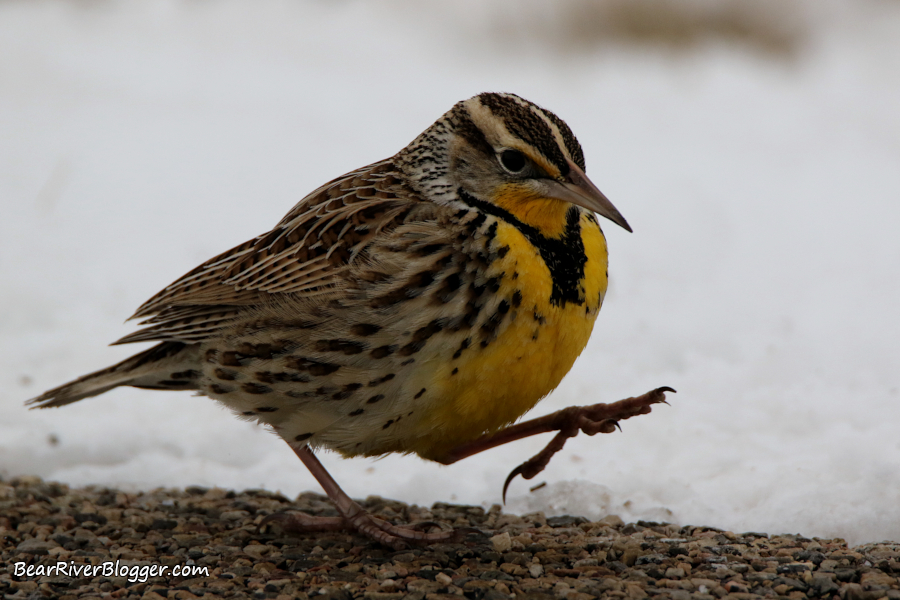
Throughout various parts of the year, food is readily available as western meadowlarks eat insects, grains, and weed seeds, but during the harshest parts of winter on the bird refuge the pickings are pretty slim at best and the only food available is fallen weed seeds, if the birds can find them that is.
Everywhere I looked, the landscape was buried under a couple of inches of encrusted snow that, unfortunately, covered the fallen seeds and the persistent little meadowlark’s only hope, it seemed, was to wander up and down the edge of the asphalt roadway in search of what remaining seeds it could find where the snow and asphalt met.
The intent and purpose of this meadowlark I just mentioned, well, it was on display in full form as it eagerly searched for food and I had to grab what photographs I could of this tenacious little meadowlark doing his best to survive because until this very day, I had no idea just how determined and intelligent western meadowlarks really are.
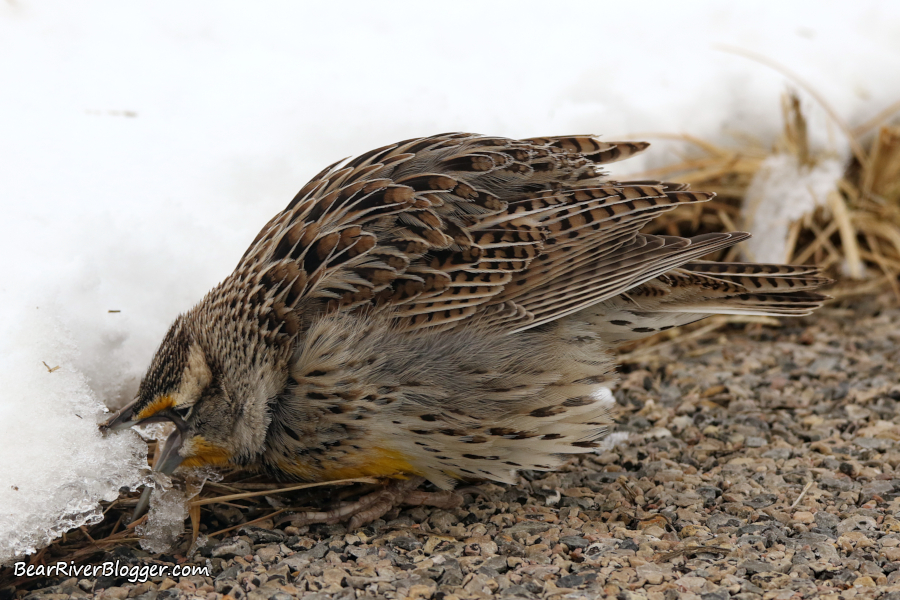
Slowly and meticulously, the little meadowlark searched every inch of the exposed roadway’s edge for whatever seeds it could find, many times using its beak to break loose and forcefully toss pieces of ice out of its way to uncover a previously hidden stash of food.
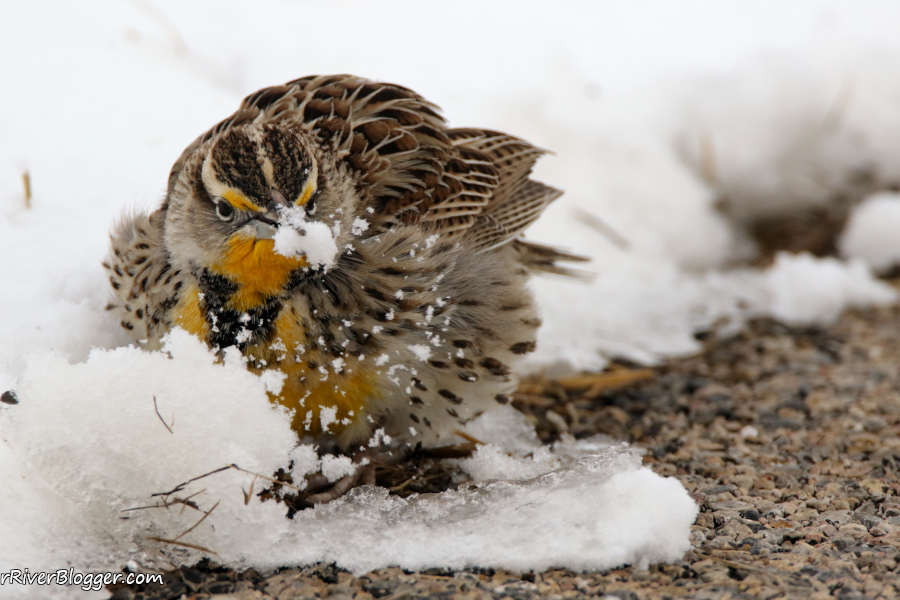
This wasn’t a random behavior either, as I watched the meadowlark flip chunk of ice after chunk of ice as it slowly walked the edge of the roadway with its eyes constantly scanning the ground for even the smallest of seeds.
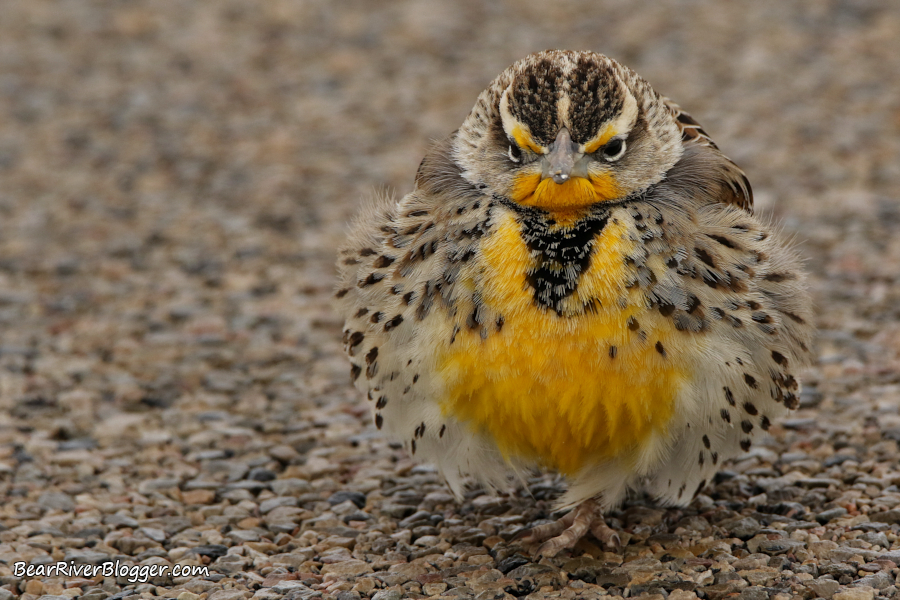
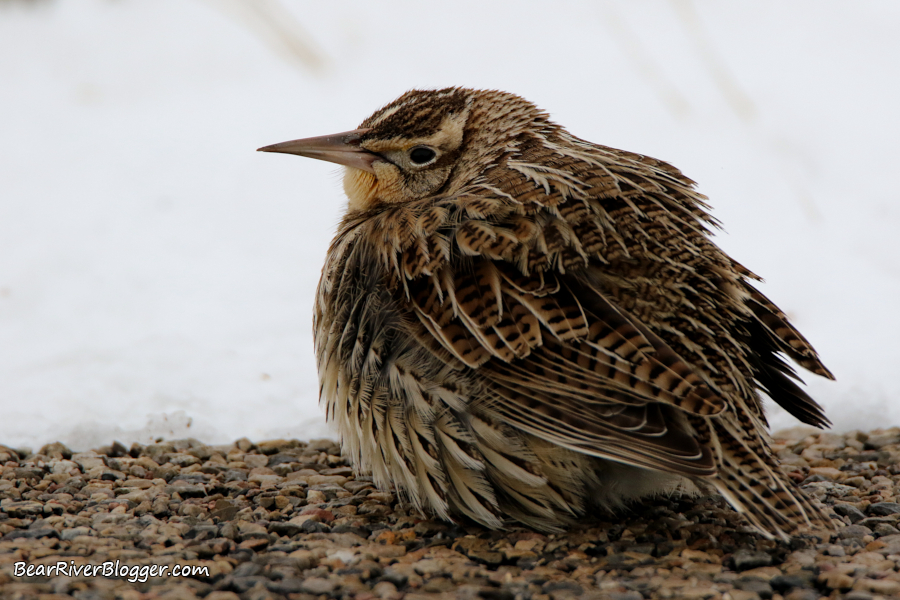
The search for food was only interrupted by brief moments when the meadowlark stopped and fluffed up its feathers for a bit, a tactic birds use to warm up in such extreme temperatures.
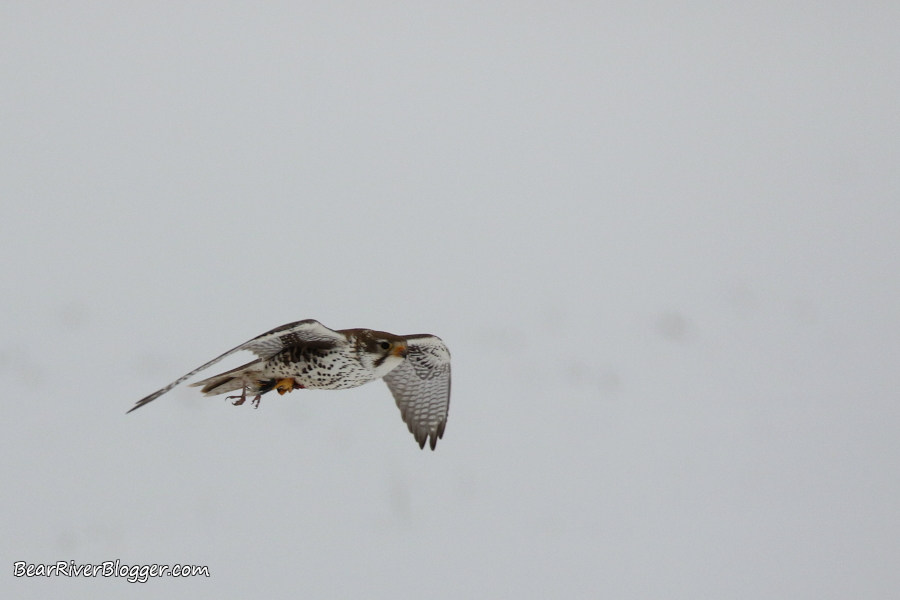
On one of those breaks, a much larger bird caught my eye as it flew by just up the road, a prairie falcon that appeared to have a meadowlark in its talons, which only adds to the dangers of the season for these most melodic of songbirds.
After a few minutes of rest and warming up, the search for food quickly continued as he slowly but intently wandered down the road, flipping over small chunks of ice and searching around the bases of nearby clumps of grass, anywhere a wayward but desperately needed seed might be found.
This was no isolated behavior; other meadowlarks were found further along the roadway and I watched the exact same behavior in them as well.
Apparently, what I witnessed on this cold winters day, is a behavior called “gaping” and is common with meadowlarks during spring and summer when they forage for insects by systematically probing the soil with their beaks, poking, flipping, and prying open dirt clods, similar to what I witnessed with the ice chunks, in search of ants, grasshoppers, crickets, and beetles.
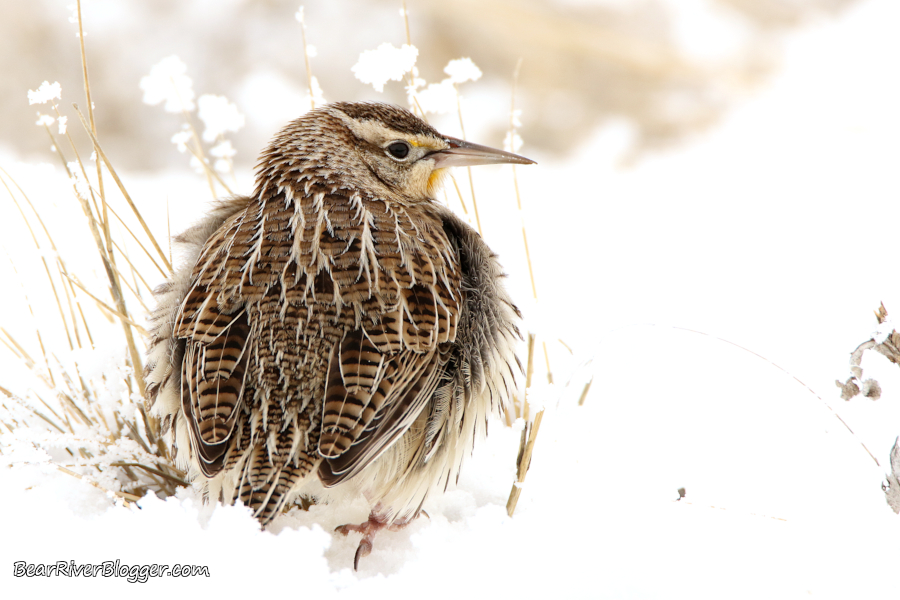
Moments like this wintry day are the best opportunities to learn about birds and are actually available every day if we choose to venture out in nature and patiently look for them.
I certainly enjoy sitting and watching birds as they interact with each other and the environment.
This was definitely one of those times; however, the best part of birdwatching is learning something new that helps foster and grow a love for birds and nature as a whole.
If you are like me, an avid birdwatcher and/or a nature photographer, I invite you to subscribe to our website and sign up for email notifications for future blog posts where I share my love of birds and nature through photography and the written word.
(Singing Western Meadowlark. For short nature photography tips and interesting stories about the natural world around us, subscribe to our Bear River Blogger channel on YouTube for videos and updates from our travels while out in nature, both on and off of the famed Bear River Migratory Bird Refuge.)