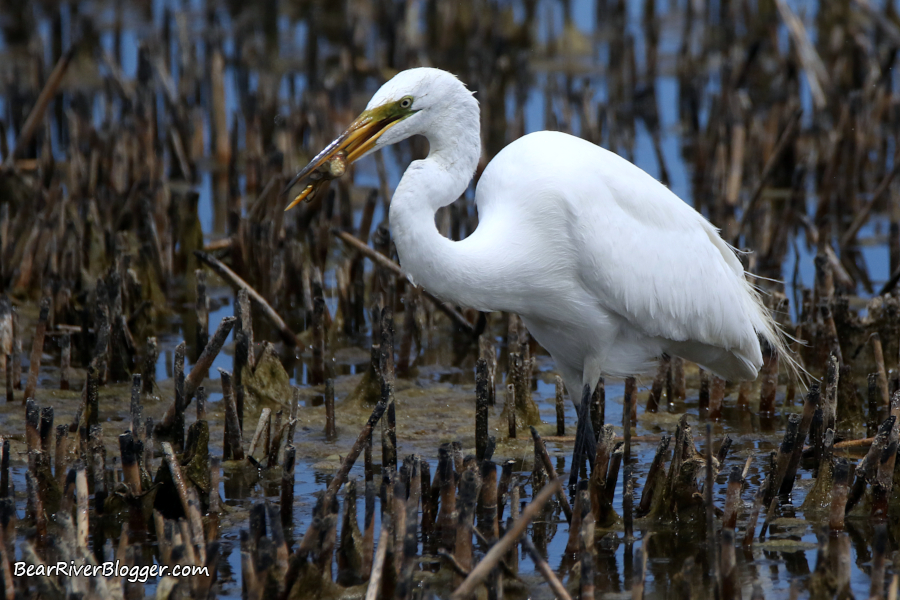
It’s been quite an interesting summer birdwatching on the Bear River Migratory Bird Refuge temporary auto tour route this year, and the most peculiar and exciting part of it all, at least for me, was the large number of great egrets I found on the refuge just a couple of months ago.
I call it peculiar in the sense that most of the range maps I look at pertaining to great egrets show they are, at best, a rarity in northern Utah, but I have to ponder that assessment based on how many I saw this year and how consistently I’ve seen them during previous years in various marshes up and down the Great Salt Lake, from Farmington Bay WMA down south to the Bear River Migratory Bird Refuge auto tour route up north in Box Elder County.
This summer might have been an anomaly, I will admit, with so many great egrets on the refuge auto tour route, but I do find them each and every year on the refuge, and they are, in fact, listed on their ‘bird list’ as being known to breed within the sanctuary’s borders, so I think they are more common than what has been traditionally thought.
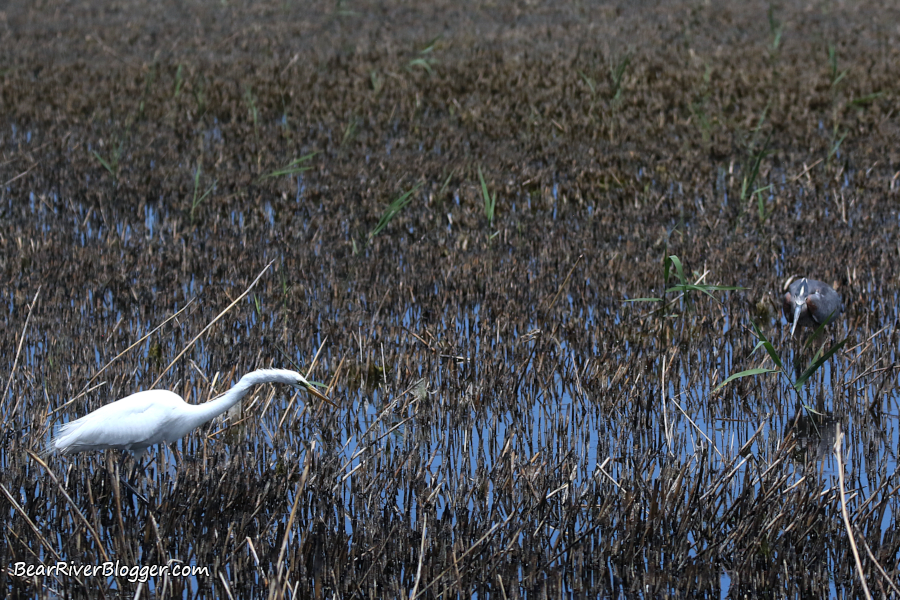
Great egrets are very similar in size and diet to the great blue heron, both slowly stalking shallow wetlands for fish, frogs, crustaceans, insects, snakes, small mammals, and even birds when the opportunity presents itself, and it was quite common to see both great egrets and great blue herons hunting in the same vicinity along the 12-mile drive.
Oftentimes, the great blue heron would eventually chase the egret away, but not always, as there were several instances the two stood almost side-by-side and stalked the shallow waters without even a thought of the other, causing me to wonder why sometimes they are arch rivals, and other times they are polite neighbors.
Also, similar to the great blue heron, great egrets are colonial nesters and typically establish their rookeries in trees and shrubs near wetlands, which does make it sound quite odd that there are so many on the refuge this year, as the available habitat really doesn’t have the preferred flora to support much of a nesting population of egrets.
I’d presume that great egrets would nest on the ground like great blue herons do if there are no other alternatives, but unlike the herons, which I did observe nesting on the large islands along the auto route, I never saw any nesting great egrets, so I am wondering why so many juvenile egrets were found in large groups this summer about halfway up the auto route.
The time of year these juvenile great egrets were observed would indicate it wasn’t any type of migration activity but the result of nesting season, being still in the dog days of summer and the egrets showing signs of adolescence while trying to figure out how to hunt and stalk prey in the reed stubble.
Numerous loose groups of what were definitely juvenile great egrets hunting the shallow wetlands imply there was some kind of a successful breeding season on the refuge, but I wonder where it took place, as these large white birds stand out like a sore thumb among the dark green vegetation and would have been easily spotted, even if they partook in nesting on the ground away off.
Well, regardless of the reason, there was quite an abundance of juvenile great egrets spotted along the temporary auto tour route; seeing so many for those few weeks was definitely the highlight of my birdwatching summer on the Bear River Migratory Bird Refuge.
Don’t get me wrong, there were other great moments on the refuge auto tour route that I will add to this website in the coming weeks, so don’t forget to subscribe, but it was the large number of great egrets that literally just showed up one day along the roadway which really impressed me this summer, and I am glad I was able to experience it in person.
Subscribe to our website
News, Events, Shopping, and More
T-shirts, Hoodies, and Gifts




Our YouTube Video Of The Week
(For short nature photography tips and interesting stories about the natural world around us, subscribe to our Bear River Blogger channel on YouTube for videos and updates from our travels while out in nature, both on and off of the famed Bear River Migratory Bird Refuge.)